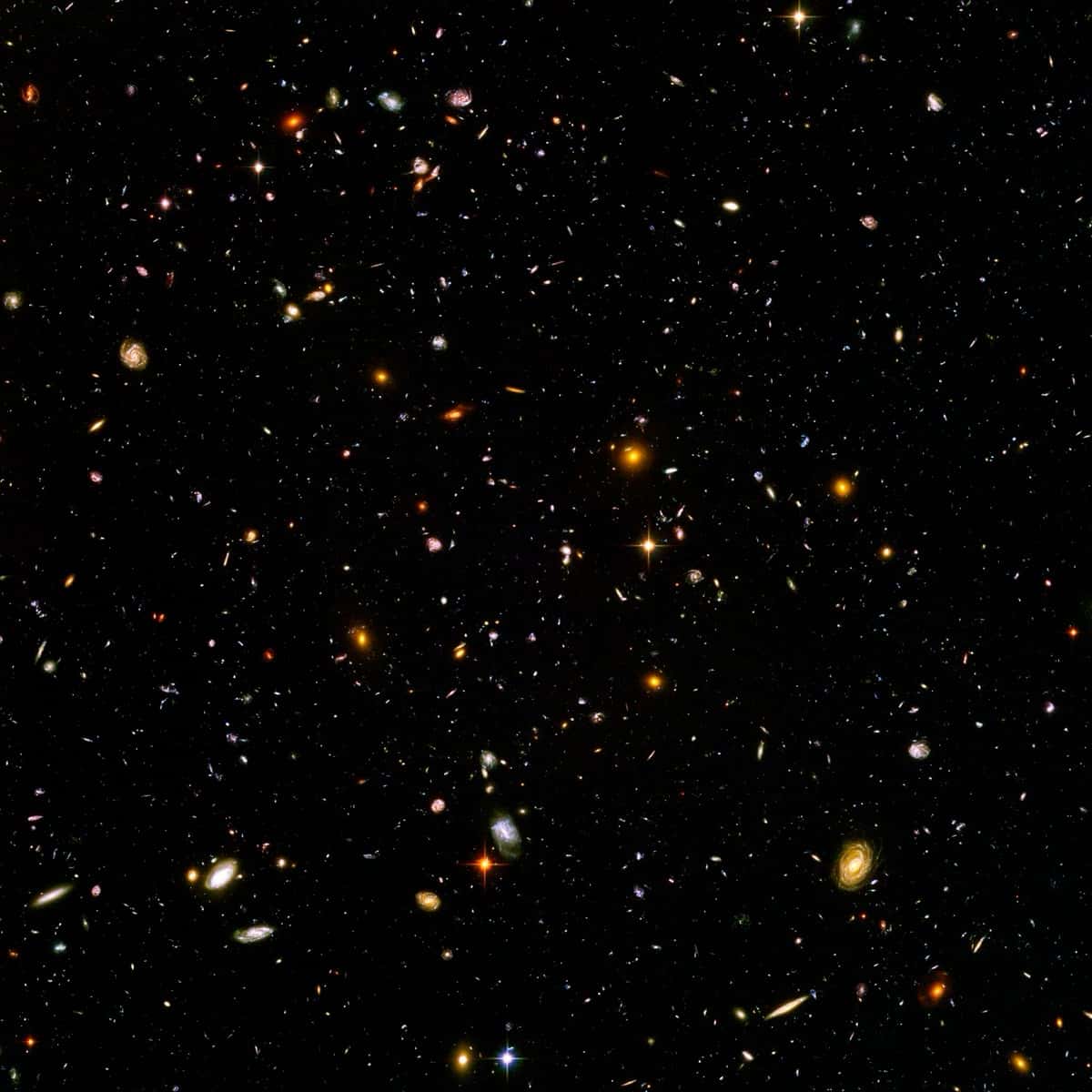
Eighty-five percent of the universe's mass has never been seen. We can weigh it. We cannot name it.
HUBBLE ULTRA DEEP FIELD · NASA/ESA · PUBLIC DOMAIN
The known landscape
The quest to understand what the universe is made of has revealed that everything astronomers can see — every star, gas cloud, and galaxy — accounts for only a small share of its mass. Modern cosmology holds that roughly 85 percent of the universe's mass is an invisible, non-luminous substance called dark matter, mapped almost entirely through its gravity.
The first hint came in 1933, when Swiss-American astronomer Fritz Zwicky studied the Coma Cluster, a group of over a thousand galaxies. Using the Doppler shifts of eight galaxies and the virial theorem, he found the cluster's galaxies moving far too fast to stay bound by the gravity of their visible matter alone — the cluster's true mass had to be hundreds of times greater than its luminous output suggested. Zwicky called it "dunkle Materie," dark matter — a phrase already in circulation among astronomers studying the dynamics of the local Milky Way, and used by Henri Poincaré as early as 1906 — but his finding was largely dismissed for decades.
The turning point came in the late 1960s and 1970s, when astronomer Vera Rubin and instrument designer W. Kent Ford, working at the Carnegie Institution of Washington, measured the rotation speeds of stars and gas across spiral galaxies. In 1970 they mapped 67 regions of the Andromeda Galaxy and found that, instead of slowing down toward the galaxy's edge as Kepler's laws predicted, orbital speeds stayed flat. By 1980, Rubin, Ford, and Norbert Thonnard confirmed the pattern across 21 spiral galaxies ranging from the small NGC 4605 to the vast UGC 2885 — every one showed the same flat rotation curve, implying unseen mass extending well beyond each galaxy's visible disk.
Direct proof that this mass is a distinct physical substance, not a flaw in our understanding of gravity, arrived in 2006. Douglas Clowe's team studied the Bullet Cluster, the aftermath of two galaxy clusters colliding. Using gravitational lensing, they found that most of the mass had passed straight through the collision, separated from the hot gas that held most of the ordinary matter — an eight-standard-deviation split between where the mass was and where the visible matter was. The Cosmic Microwave Background, mapped by missions including the Planck satellite, independently confirms the same Lambda Cold Dark Matter (ΛCDM) picture at cosmological scales.
The edge
Astronomers can weigh dark matter, map its distribution across billions of light-years, and trace its role in building galaxies — yet no experiment has identified a single particle it is made of. Because dark matter does not emit, absorb, or reflect light, it is invisible to every instrument built around detecting the electromagnetic spectrum, which is why the search has stalled at the boundary between what gravity reveals and what particle physics can confirm.
The leading candidate for decades has been the Weakly Interacting Massive Particle, or WIMP — a particle with roughly the mass of a heavy atomic nucleus (between 10 and 1000 GeV) that would naturally have "frozen out" of the early universe in exactly the quantity needed to match the 26 percent dark matter density observed today. Despite enormous underground detectors built from ultra-pure liquid xenon or germanium and shielded by kilometers of rock, WIMPs have never been directly detected, and the field is approaching the "neutrino floor," where background neutrino noise will make an ordinary WIMP recoil nearly impossible to isolate. Other candidates include the axion, an ultra-light particle theorized to solve an unrelated problem in particle physics, and more complex "dark sector" models in which dark matter is not one particle but a family of them.
A rival explanation abandons the particle hypothesis altogether. Modified Newtonian Dynamics (MOND), proposed by Mordehai Milgrom in 1983, holds that there is no invisible matter — gravity itself simply behaves differently at the extremely low accelerations found at a galaxy's outer edge. MOND predicts flat rotation curves elegantly using only visible mass, but it cannot explain the motions within galaxy clusters, and it fails outright at the Bullet Cluster, where the offset between mass and visible gas is exactly what a particle explanation predicts and a pure modification of gravity cannot produce.
The impasse is not a failure of effort but a mismatch of tools: four centuries of astronomy were built to detect light, and dark matter, by definition, gives off none. Resolving its nature will require either a direct particle detection that has eluded physicists for decades, or a new theoretical framework nobody has yet devised.
From the archive
For 21 Sc galaxies whose properties encompass a wide range of radii, masses, and luminosities, we have obtained major axis spectra extending to the faint outer regions, and have deduced rotation curves. [...] All curves show a fairly rapid velocity rise to V ~ 125 km s⁻¹ at R ~ 5 kpc, and a slower rise thereafter. Most rotation curves are rising slowly even at the farthest measured point. Neither high nor low luminosity Sc galaxies have falling rotation curves. Sc galaxies of all luminosities must have significant mass located beyond the optical image. [...] The conclusion is inescapable that non-luminous matter exists beyond the optical galaxy.
Vera C. Rubin, W. Kent Ford, Jr., and Norbert Thonnard (1980). Rotational Properties of 21 Sc Galaxies with a Large Range of Luminosities and Radii, from NGC 4605 (R = 4 kpc) to UGC 2885 (R = 122 kpc). The Astrophysical Journal, Vol. 238, pp. 471-487. Archive source: NASA Astrophysics Data System (ADS) / The Astrophysical Journal Archive.
Contemplative inquiry
If eighty-five percent of the universe operates entirely outside the realm of light, electromagnetic interaction, and human visibility, how does that invisible dominance alter our sense of human significance and our trust in what our senses tell us about reality?
Given the limits of the human eye and the instruments built to extend it, what other structures of reality might exist nearby, undetectable simply because we have not yet found the right way to observe them?
Further
- Vera Rubin: Opening doors to dark matter and women in STEM — Carnegie Science
- Rotation of the Andromeda Nebula from a Spectroscopic Survey of Emission Regions (1970) — OSTI.GOV
- Rotational Properties of 21 Sc Galaxies (1980), full text — NASA Astrophysics Data System
- A direct empirical proof of the existence of dark matter — arXiv
- Bullet Cluster: Direct Proof of Dark Matter — Chandra X-ray Observatory
- Gravitational lensing of the Cosmic Microwave Background — ESA Science & Technology
- Planck's gravitational lensing power spectrum — ESA Science & Technology
- A History of Dark Matter — NASA/IPAC Extragalactic Database, Caltech
- This Month in Astronomical History: June 2023 — American Astronomical Society
- What is Dark Matter? — Yale University
- Dark matter — CERN
- Bullet Cluster 1E0657-558 evidence shows modified gravity in the absence of dark matter — Oxford Academic (MNRAS) — a dissenting view: Brownstein and Moffat (2007) argue the same lensing data, 8σ offset included, can be fitted by modified gravity without non-baryonic dark matter. The body text above takes the opposite position.