Millisecond flashes of radio light arrive from other galaxies. No one is sure what makes them.
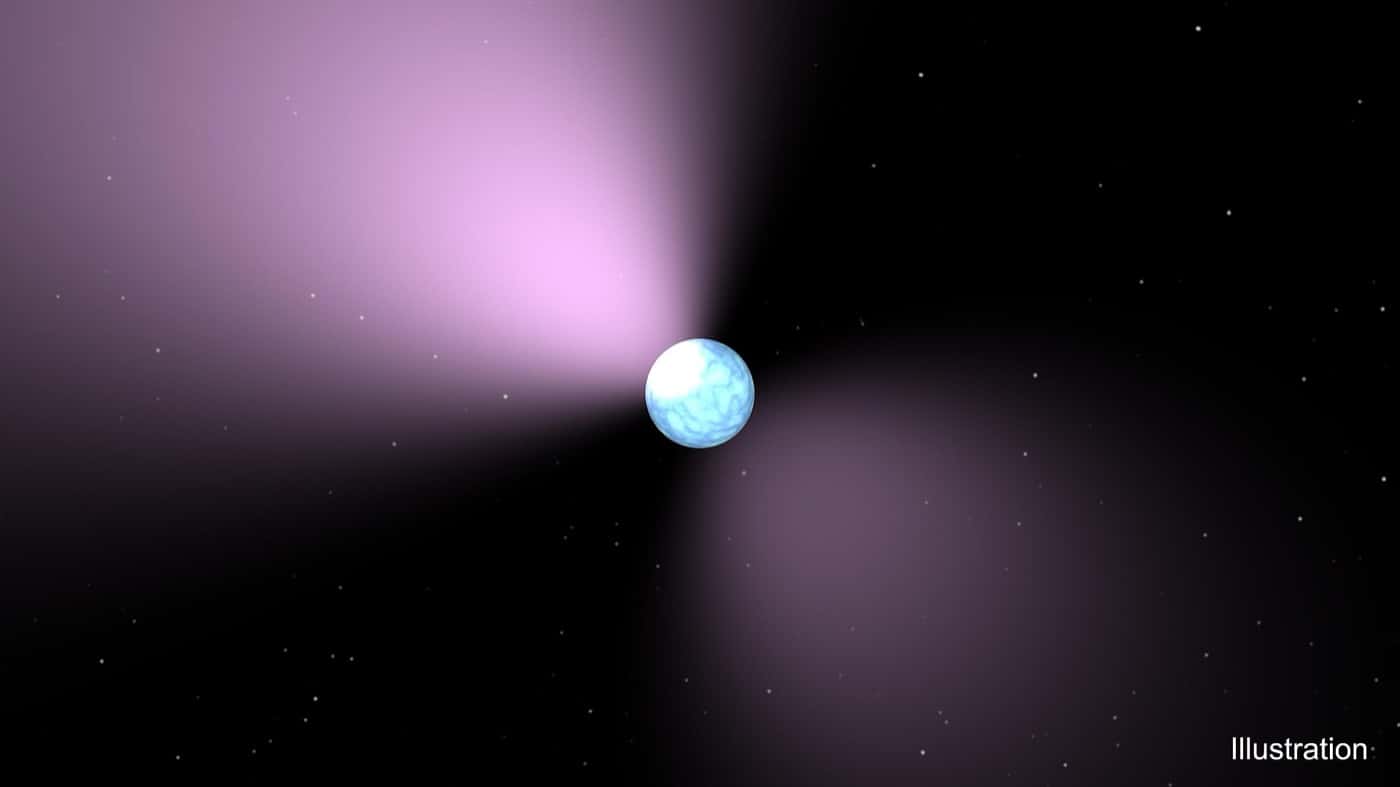
PULSAR, ARTIST'S CONCEPT · NASA/JPL-CALTECH · PUBLIC DOMAIN
The known landscape
For most of radio astronomy's history, the time-domain sky was assumed to belong to periodic emitters: pulsars, the spinning cores of dead stars, sweeping their beams past Earth with metronomic regularity. Search pipelines were built to hunt for exactly that rhythm.
That assumption broke in 2007, when astrophysicist Duncan Lorimer, together with Maura McLaughlin and undergraduate David Narkevic at West Virginia University, went back through archival data from a 2001 survey by the 64-meter Parkes Radio Telescope in Australia. Narkevic was searching that archive for single, isolated pulses rather than periodic ones. Buried in the recordings was a signal so bright it saturated the receiver's primary detection beam: a burst captured in the 2001 survey data, lasting under five milliseconds, with a peak flux originally estimated at more than 30 Janskys.
What made the "Lorimer Burst" (FRB 010724) extraordinary was its dispersion measure — the frequency-dependent delay imposed on radio waves as they pass through ionized plasma. Its dispersion measure of 375 was far too high to be explained by gas within the Milky Way or the nearby Small Magellanic Cloud; it placed the source less than a gigaparsec away, well outside our galaxy. The burst's extreme brightness ruled out ordinary thermal emission, and its brevity meant the source had to be smaller than Earth — the signature of a compact object like a neutron star.
Skepticism lingered for years; ninety hours of follow-up observation found no repeat. That changed as archival searches and new surveys turned up dozens more high-dispersion bursts. First detected in 2012, FRB 121102 became the first known repeater, later localized to a dwarf galaxy roughly three billion light-years away — proof that at least some sources survive their own eruptions. Then, on April 28, 2020, the Canadian CHIME array and the STARE2 detector both caught a millisecond radio burst, coincident with an X-ray flare, coming from a known magnetar inside our own galaxy: SGR 1935+2154. Fast Radio Bursts, once dismissed as anomalies, had a confirmed source class.
The edge
The Galactic event of April 2020 confirmed that magnetars — neutron stars with extraordinarily strong magnetic fields — can produce Fast Radio Bursts. It did not confirm that magnetars explain the entire population. FRB 200428, the burst tied to SGR 1935+2154, was some forty times fainter than the weakest extragalactic FRB yet observed, sitting neatly on the low-energy tail of the broader distribution: encouraging, but a single nearby data point beside thousands of distant, unresolved ones.
The catalog itself resists a single story. Some sources, like FRB 121102, repeat irregularly for years. Others, like FRB 180916, repeat on a stable 16.35-day cycle, hinting at binary orbital motion or precession. Many bursts have never repeated at all, which keeps cataclysmic, one-time origins — colliding neutron stars, evaporating primordial black holes — alive as explanations for at least part of the population. Whether repeaters and apparent one-off bursts are different phenomena, or the same phenomenon caught at different moments, remains unsettled.
The polarization data deepens rather than resolves the puzzle. Some bursts arrive almost entirely linearly polarized; others carry significant circular polarization, thought to arise as the burst's radiation passes through a magnetar's own relativistic wind. But the absence of measurable circular polarization in many bursts could reflect genuine variation in the source environment, or simply the limits of instrumental frequency resolution smearing a rapidly oscillating signal past detection — an ambiguity current telescopes cannot cleanly separate.
The deeper obstacle is distance. Nearly every known FRB source lies too far away, and each event lasts too briefly, for any instrument to resolve the emitting region directly or catch simultaneous multi-wavelength counterparts. Only the one Galactic event offered that kind of direct correspondence between mechanism and signal. Until more such events occur nearby, models of what triggers each flash, and why some sources repeat while others apparently do not, rest on inference and analogy rather than direct observation.
From the archive
In analysis of archival survey data, we have discovered a 30-Jy dispersed burst of duration <5 ms located three degrees from the Small Magellanic Cloud. The burst properties argue against a physical association with our Galaxy or the Small Magellanic Cloud. Current models for the free electron content in the Universe imply a distance to the burst of <1 Gpc.
D. R. Lorimer, M. Bailes, M. A. McLaughlin, D. J. Narkevic & F. Crawford, "A bright millisecond radio burst of extragalactic origin," Science 318, 777 (2 November 2007). Preprint archived at arXiv:0709.4301.
Contemplative inquiry
Each Fast Radio Burst carries, encoded in its dispersion, a record of every free electron it crossed on a journey of billions of years — tracing matter too diffuse and dark to ever see directly. What does it mean that a signal lasting a few thousandths of a second can serve as a more patient witness to the universe's hidden structure than centuries of watching the sky for light?
The Lorimer Burst sat unnoticed in an archive for six years before anyone searched the data in the way that revealed its nature. How many other transformative discoveries might already be sitting, unread, in observations we have already collected, waiting only for someone to ask the right question of them?
Further
- Lorimer et al. 2007, "A bright millisecond radio burst of extragalactic origin" (Science) — arXiv preprint
- Mazzella 2019, "Episode 10 - Five Milliseconds" (Sparked podcast, transcript; with Lorimer, McLaughlin and Burke-Spolaor on the archival search that found the first burst) — WVU Magazine, West Virginia University
- Bochenek et al. 2020, "A fast radio burst associated with a Galactic magnetar" (STARE2, Nature) — arXiv preprint
- CHIME/FRB Collaboration 2020, "A bright millisecond-duration radio burst from a Galactic magnetar" (Nature) — arXiv preprint
- Macquart et al. 2020, "A census of baryons in the Universe from localized fast radio bursts" (Nature) — arXiv preprint
- Petroff, Hessels & Lorimer 2019, "Fast radio bursts" (Astronomy & Astrophysics Review) — PMC, National Institutes of Health
- Core Concept: Unraveling the enigma of fast radio bursts — PMC, National Institutes of Health
- Katz, "Fast Radio Bursts" (Encyclopedia of Astrophysics) — arXiv
- Constraining the near-source relativistic wind medium using Fast Radio Burst circular polarization data — arXiv