In 1986 a ceramic began carrying current with no resistance far above any theory allowed. What pairs the electrons still has no agreed answer.
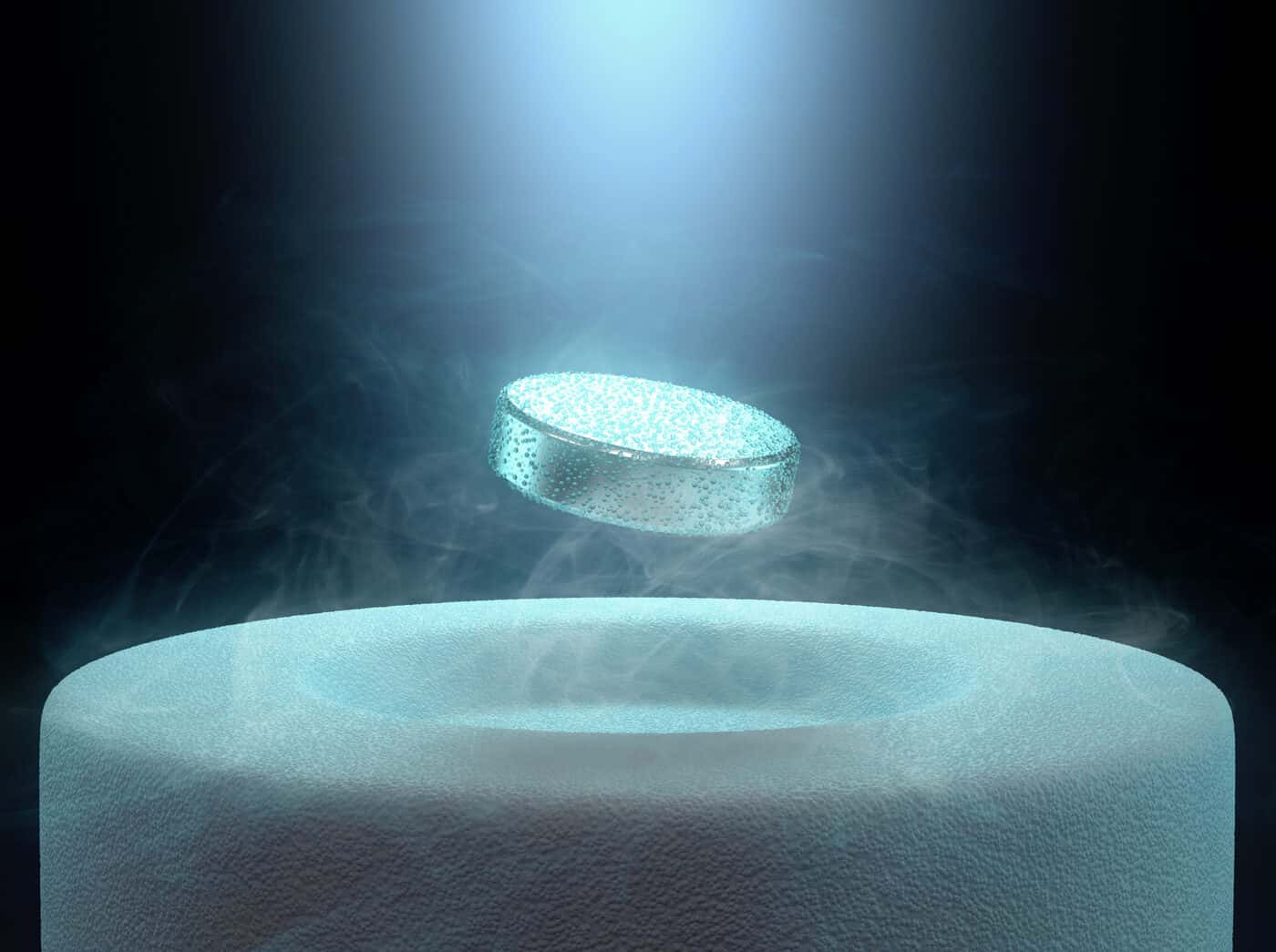
SUPERCONDUCTOR LEVITATION · U.S. DEPARTMENT OF ENERGY / ARGONNE NATIONAL LABORATORY · PUBLIC DOMAIN
The known landscape
For most of the twentieth century, physicists believed superconductivity had a firm ceiling. Bardeen-Cooper-Schrieffer (BCS) theory explained how electrons pair up and flow without resistance when a material is cooled near absolute zero, and the McMillan limit built into that theory implied a ceiling on phonon-mediated pairing in the low tens of kelvin, commonly quoted somewhere near 30 to 40 K. The empirical record, set in 1973 by a niobium-germanium intermetallic (Nb3Ge) at 23.3 K, then stood unbroken for over a decade, and the consensus was that transition temperatures were nearing a practical ceiling.
In 1986, researchers J. Georg Bednorz and K. Alex Müller broke that ceiling. Investigating a layered, copper-containing ceramic in the barium-lanthanum-copper-oxide system — a class of materials called perovskites, not the metallic alloys physicists had assumed would carry superconductivity's future — they measured resistance collapsing by up to three orders of magnitude near 30 K. It was a modest number on its own, but it shattered a limit that had looked immovable and pointed toward an entirely unfamiliar class of superconductors. Bednorz and Müller received the Nobel Prize in Physics the following year, one of the fastest such recognitions on record.
The larger shock came within months, when a related yttrium-barium-copper-oxide compound was found to superconduct between roughly 80 and 93 kelvin at ordinary pressure — comfortably above 77 K, the boiling point of liquid nitrogen. Superconductivity, previously sustained only with costly liquid helium, could now be maintained with cheap, plentiful liquid nitrogen.
These materials, now called cuprates, share a structure: sheets of copper and oxygen atoms, the CuO2 planes, that carry the supercurrent, layered between insulating regions. Their parent compounds are antiferromagnetic Mott insulators; only after they are chemically doped with extra charge carriers does superconductivity appear. That such elevated transition temperatures existed at all told physicists immediately that the standard phonon-mediated BCS mechanism could not be the whole story — something else was pairing the electrons.
The edge
Four decades after Bednorz and Müller's discovery, physicists can describe cuprate superconductivity with remarkable precision — its transition temperatures, its unconventional pairing symmetry, its response to magnetic fields — without agreeing on what actually binds the electrons together.
Several rival pictures compete for the role BCS phonons once played. Philip Anderson's resonating valence bond (RVB) theory proposes that the undoped material's electron spins never freeze into an ordinary magnetic lattice at all, but instead form a fluctuating, quantum-entangled "liquid" of paired spins that becomes mobile and superconducting once the material is doped. A related approach, the Zhang-Rice singlet, models each doped hole as tightly bound to a neighboring copper spin, reducing the crystal's complex multi-band physics to a more tractable single-band problem. Older polaron and bipolaron theories instead emphasize distortions of the crystal lattice around each electron, while more recent work on "stripe order" finds charge carriers segregating into one-dimensional rivers that appear to favor the pairing symmetry actually observed. In the iron-based superconductors discovered later, superconductivity and antiferromagnetism have been shown to coexist rather than compete, adding another constraint any final theory must satisfy.
No experiment has forced a choice among these pictures, and the reason is structural rather than a matter of better instruments. Cuprates are strongly correlated materials: the mathematics that works for ordinary metals, treating electrons as nearly independent particles subject to small perturbations, breaks down once electron-electron repulsion dominates their behavior. The simplified models built to capture that regime, such as the Hubbard model, have never been solved exactly for the parameters relevant to real cuprates. Every competing theory captures part of the experimental picture, and none captures all of it — which is why, decades on, condensed matter physics still has no settled answer to what is arguably its central open question: what pairs the electrons.
From the archive
During cooling, however, a metallic-like decrease was first observed, followed by an increase at low temperatures, indicating a transition to localization. My inner tension, always increasing as the temperature approached the 30 K range, started to be released when a sudden resistivity drop of 50% occurred at 11 K. Was this the first indication of superconductivity? Alex and I were really excited, as repeated measurements showed perfect reproducibility and an error could be excluded. Compositions as well as the thermal treatment were varied and within two weeks we were able to shift the onset of the resistivity drop to 35 K.
J. Georg Bednorz, recalling the discovery, from the Nobel Lecture "Perovskite-type oxides — the new approach to high-Tc superconductivity," delivered with K. Alex Müller, 8 December 1987. Archived by The Nobel Foundation (nobelprize.org).
Contemplative inquiry
A material that carries current without measurable loss went unnoticed for most of the twentieth century simply because no one thought to look past the metals already understood. What other properties might be waiting in combinations of ordinary materials that have not yet been tried?
Physicists can describe cuprate superconductivity with exquisite precision, and even build devices from it, while disagreeing about what causes it at the most basic level. What does it mean to master a phenomenon in practice while its underlying reason remains genuinely contested?
Further
- J. G. Bednorz and K. A. Müller (1986), "Possible high Tc superconductivity in the Ba-La-Cu-O system," Zeitschrift für Physik B 64, 189–193
- J. Georg Bednorz and K. Alex Müller — Nobel Lecture, "Perovskite-type oxides — the new approach to high-Tc superconductivity"
- M. K. Wu et al. (1987), "Superconductivity at 93 K in a new mixed-phase Y-Ba-Cu-O compound system at ambient pressure," Physical Review Letters 58, 908
- SLAC National Accelerator Laboratory — "Researchers observe 'locked' electron pairs in a superconductor cuprate" (on the still-unexplained cuprate pairing mechanism)
- S. M. O'Mahony, J. C. S. Davis et al. (2022), "On the electron pairing mechanism of copper-oxide high temperature superconductivity," Proceedings of the National Academy of Sciences 119, e2207449119