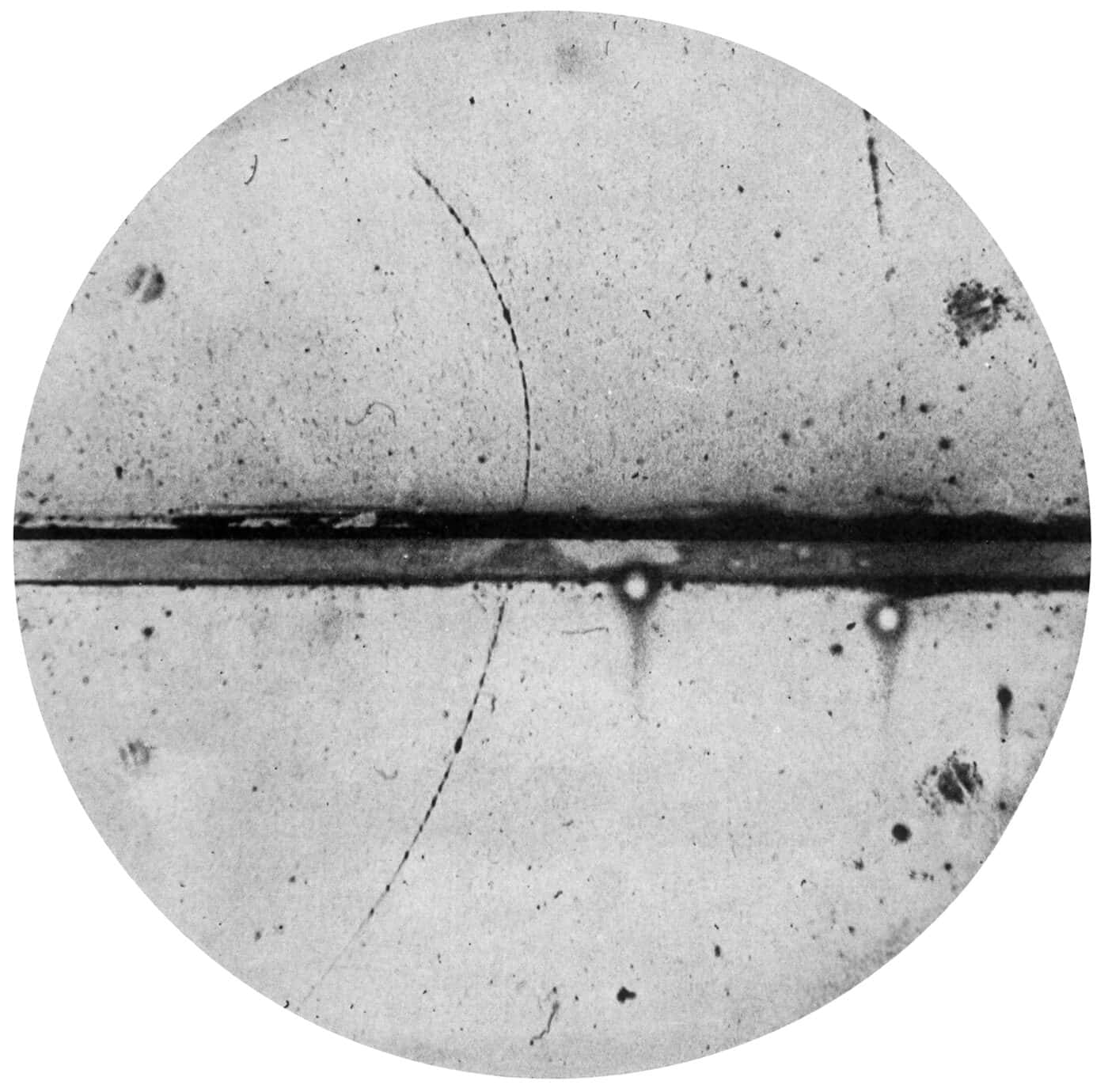
Matter and antimatter should have annihilated each other completely in the universe's first instant. Something tipped the balance by about one part in a billion, and no experiment has found what.
POSITRON CLOUD CHAMBER TRACK, 1932 · CARL D. ANDERSON, CALTECH · PUBLIC DOMAIN
The known landscape
Every fundamental particle of matter has an antimatter twin, identical in mass but opposite in charge and other quantum properties. Paul Dirac's 1928 equation describing the electron demanded this: alongside the ordinary, positive-energy electron, the mathematics allowed for a mirror particle. Four years later, at Caltech, Carl Anderson found it in cosmic-ray cloud-chamber tracks — a particle with an electron's mass and a positive charge, which he named the positron. Antiprotons, antineutrons, and a whole antimatter family followed, each one matching its ordinary counterpart in mass, spin, and half-life while reversing every additive quantum number.
If matter and antimatter are true mirror images, the early universe's superheated plasma should have produced them in equal numbers — and as that plasma cooled, it should have annihilated itself almost completely, leaving a universe of radiation with no galaxies, stars, or people. Measurements of the cosmic microwave background and the light-element abundances left from Big Bang nucleosynthesis confirm that this near-total annihilation did happen, with one exception: for roughly every billion antimatter particles, about a billion and one matter particles existed. That tiny surviving fraction became everything visible today.
The discovery that nature does not, in fact, treat matter and antimatter identically came in stages: parity violation in the weak force in 1957, then combined charge-parity (CP) violation in the decay of neutral kaons in 1964 — direct proof that some processes run at different rates for matter and antimatter. In 1967, Soviet physicist Andrei Sakharov formalized what any theory would need to explain the imbalance: interactions that change the total number of matter particles, both C and CP violation, and conditions far from thermal equilibrium. Trace antimatter still appears in ordinary life — a banana emits roughly fifteen positrons a day from the radioactive decay of potassium-40 — vanishing instantly on contact with matter.
The edge
The Standard Model contains, in principle, all three of Sakharov's ingredients. The count of matter particles can change non-perturbatively through so-called sphaleron processes, which were unsuppressed at early-universe temperatures. CP violation is built into the way quarks mix, carried by a complex phase in the Cabibbo-Kobayashi-Maskawa matrix. And the electroweak transition, when the Higgs field switched on and particles acquired mass, offered a possible departure from equilibrium. The trouble is one of magnitude, not existence: CKM-matrix CP violation is roughly ten orders of magnitude too small to generate the observed asymmetry, and in the Standard Model the electroweak transition turns out to be a smooth crossover rather than a sharp, bubble-nucleating phase change — too gentle to freeze in any baryon excess before sphaleron processes erase it again. The Standard Model has the right shape of an explanation and the wrong size.
That gap is why current research hunts for extra sources of CP violation beyond the Standard Model. The LHCb collaboration has reported the first observation of CP violation in the decay of a baryon rather than a meson, comparing the decay rates of a beauty baryon and its antimatter counterpart across distinct regions of its decay's phase space. ATLAS has searched the Higgs sector for CP-violating couplings to the electroweak gauge bosons, constraining a CP-mixing parameter to a narrow range consistent with zero. Electric-dipole-moment experiments — hunting for a minuscule, forbidden separation of charge inside particles like the electron, neutron, and muon — have pushed their limits far below where new CP-violating physics is predicted to sit, without finding one. Each result narrows the space where new physics could hide; none has yet found it, because every method built to detect it is, so far, more precise than the effect it is looking for.
Beyond the Standard Model, competing frameworks try to supply the missing size. Electroweak baryogenesis models add new scalar fields that make the phase transition sharp enough to trap an asymmetry, with the lightest such field sometimes proposed as a dark matter candidate in its own right. Asymmetric dark matter models go further, proposing that dark matter carries its own conserved charge and its own primordial asymmetry, linked to ordinary matter through what theorists call a "neutron portal" — an elegant idea, since the two forms of matter exist today in strikingly similar abundance. At the furthest edge, a minority of physicists argue the puzzle cannot be resolved within particle physics at all, and propose instead that a mirror "twin" universe born from the same singularity carries the missing antimatter. A related conjecture — that antimatter falls upward under gravity — has already been narrowed by direct test: at CERN, the ALPHA collaboration watched antihydrogen fall downward at close to ordinary gravity, consistent with general relativity. The twin-universe picture has no such experimental foothold, and survives only because current instruments cannot yet rule it out. Even the newest speculative link — that violently uneven pockets of matter creation during the phase transition might have collapsed directly into the earliest supermassive black holes now glimpsed by the James Webb Space Telescope — remains a hypothesis awaiting a test no telescope or collider can yet perform.
Contemplative inquiry
If the entire visible universe exists because of an imbalance of roughly one particle in a billion, what does it mean to think of matter itself as a narrow margin that survived, rather than something inevitable?
Physicists have spent decades building instruments sensitive enough to detect the faintest known asymmetries, and have mostly kept finding balance where they hoped to find a tilt. What does that kind of patient, often negative search ask of the people who spend careers on it?
Further
- Antimatter — arXiv
- ALPHA-g clocks the freefall of antihydrogen — CERN Courier
- The Violation of Symmetry between Matter and Antimatter — CERN (Indico)
- Observation of charge–parity symmetry breaking in baryon decays — PMC, NIH
- Test of CP Invariance in vector-boson fusion production of the Higgs boson using the Optimal Observable method (ATLAS, 2016) — University of Birmingham
- A new bound on the electron's electric dipole moment (Science, 2023) — arXiv
- Bubble Trouble: a Review on Electroweak Baryogenesis — arXiv
- An Overview of the Searches for the Violation of the Charge-Parity Symmetry in the Leptonic Sector — MDPI (Symmetry)
- Baryogenesis: A Symmetry Breaking in the Primordial Universe Revisited — MDPI (Symmetry)
- A symmetric universe: matter-antimatter asymmetry and dark matter from baryon number conservation — mediaTUM, Technical University of Munich
- The Genesis of Giants: Tracing the Early Development of Supermassive Black Holes — Chandra X-ray Observatory
- How did supermassive black holes form in the early universe? — Inside UCR, UC Riverside