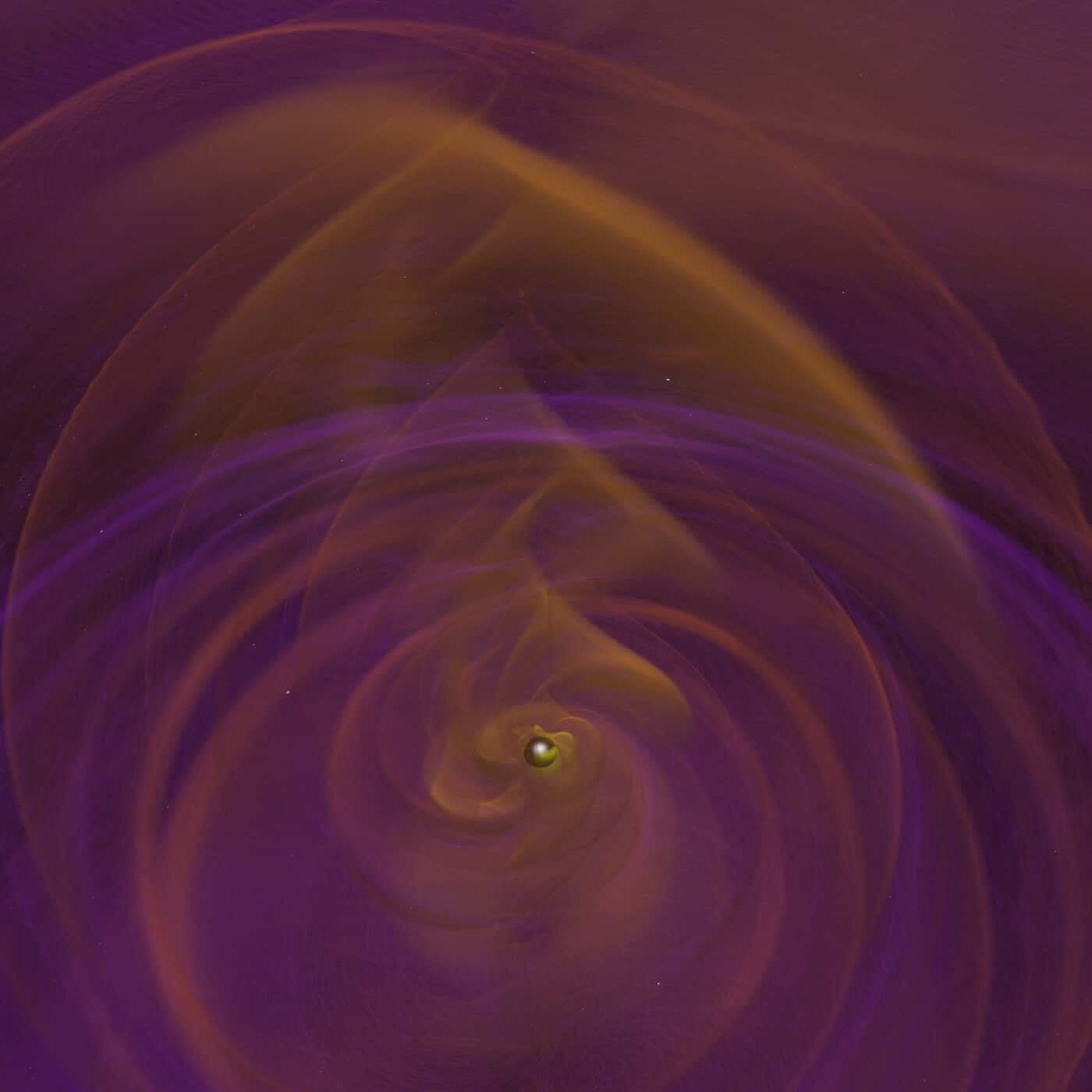
General relativity and quantum mechanics each work with total precision. No one has found the equation where both are true at once.
BLACK HOLE MERGER SIMULATION · NASA/C. HENZE · PUBLIC DOMAIN
The known landscape
General relativity, formulated by Albert Einstein, describes gravity not as a force but as the curvature of spacetime caused by mass and energy, and its predictions have been confirmed to exquisite precision at planetary and cosmological scales. Quantum mechanics, and its relativistic extension quantum field theory, governs the strong, weak, and electromagnetic forces through a discrete, probabilistic framework, and has proven equally precise inside atoms and particle accelerators. The two theories work, separately, with remarkable accuracy — but they rest on incompatible foundations, and no experiment has yet forced them together. At the extreme densities of a black hole's interior or the first instant of the universe, where both gravity and quantum effects should matter at once, the two frameworks generate contradictions rather than predictions.
The most direct attempt to unite them, canonical quantum gravity, originated in the late 1960s by applying the mathematics of quantum theory directly to general relativity. Because Einstein's equations are invariant under changes of coordinates, the resulting Hamiltonian is not a generator of time evolution but a constraint that must equal zero — the Wheeler-DeWitt equation, Ĥ|Ψ⟩ = 0, which functions as a Schrödinger equation for the wave function of the entire universe. Solving the equation exactly would require integrating over every possible spatial geometry and matter configuration, a task still beyond computation; physicists instead study simplified "minisuperspace" models restricted to highly symmetric universes.
An alternative approach, Loop Quantum Gravity, quantizes the geometry of space itself, using a reformulation of general relativity built on Ashtekar variables. It proposes that space is not continuous but woven from discrete loops into a fine structure called a spin network, with continuous spacetime emerging only at scales far larger than the Planck length of 10⁻³⁵ meters. Unlike approaches that treat spacetime as a fixed backdrop for physics to play out on, Loop Quantum Gravity is built to require no backdrop at all — a property known as background independence.
The edge
Two structural puzzles sit at the center of quantum gravity research, and neither has a resolution in sight.
The first is the "problem of time." The Wheeler-DeWitt equation describes a universal wave function that never changes — because the universe, by definition, has nothing external to measure its own evolution against, the equation freezes into a stationary quantum state. Frameworks such as the Page-Wootters formalism attempt to recover the sensation of time relationally, treating it as something that emerges only when one part of the universe is used as a "clock" against which another part is compared. Whether time is fundamental, or a byproduct of entanglement between subsystems, remains unsettled.
The second is the fate of the Big Bang singularity. Run general relativity's equations backward, and the scale factor of the universe shrinks toward zero while density and curvature diverge to infinity — a signal, most physicists agree, that classical gravity has broken down rather than a description of physical reality. Loop Quantum Cosmology, which applies Loop Quantum Gravity's discrete geometry to cosmological models, proposes that the collapse never completes: as density approaches the Planck scale, the discreteness of space generates a repulsive quantum effect strong enough to halt the collapse and rebound it outward, replacing the singularity with a "Big Bounce" into a prior contracting universe. Solutions to the plain Wheeler-DeWitt equation, by contrast, do not universally guarantee this outcome — whether the singularity is truly erased depends on which quantum framework, and which boundary conditions, are chosen.
Both puzzles resist resolution for the same underlying reason: quantum gravitational effects only become significant at the Planck scale, an energy and length regime far beyond anything a particle accelerator can reach, and the two places general relativity predicts it should matter most — the interior of a black hole and the first instant of the universe — are hidden behind an event horizon or lost in a past no instrument can directly observe. Physicists are left comparing internally consistent mathematical frameworks, among them the canonical Wheeler-DeWitt approach and Loop Quantum Gravity, with no experiment yet capable of adjudicating between them.
Contemplative inquiry
If the wave function of the universe is genuinely timeless, and the sensation of past becoming future emerges only from the relationship between one part of the world and another, what does that suggest about the moment you are experiencing right now?
Two of physics's most trusted theories remain unmerged, each exact within its own domain and silent at the edge of the other. What does it mean to trust a body of knowledge that is precise everywhere it has been tested, and open exactly where the tests run out?
Further
- DeWitt, "Quantum Theory of Gravity. I. The Canonical Theory," Phys. Rev. 160, 1113 (1967) — NASA ADS
- Ashtekar & Singh, "Loop Quantum Cosmology: A Status Report" — arXiv
- Bohmian Quantum Cosmology from the Wheeler-DeWitt Equation — arXiv
- Struyve, "Loop quantum cosmology and singularities" — arXiv
- Rotondo, "A Wheeler–DeWitt Equation with Time" — Universe (MDPI)
- Singularity Resolution in Quantum Cosmology via Page-Wootters Formalism — arXiv
- Emergent cosmology and gravity from quantum time? — arXiv
- Critical Insight into the Cosmological Sector of Loop Quantum Gravity — arXiv
- Wheeler-DeWitt equation and the applicability of crypto-Hermitian interaction representation in quantum cosmology — arXiv