Billion-sun black holes were already shining when the universe was young. Nothing we know grows that fast.
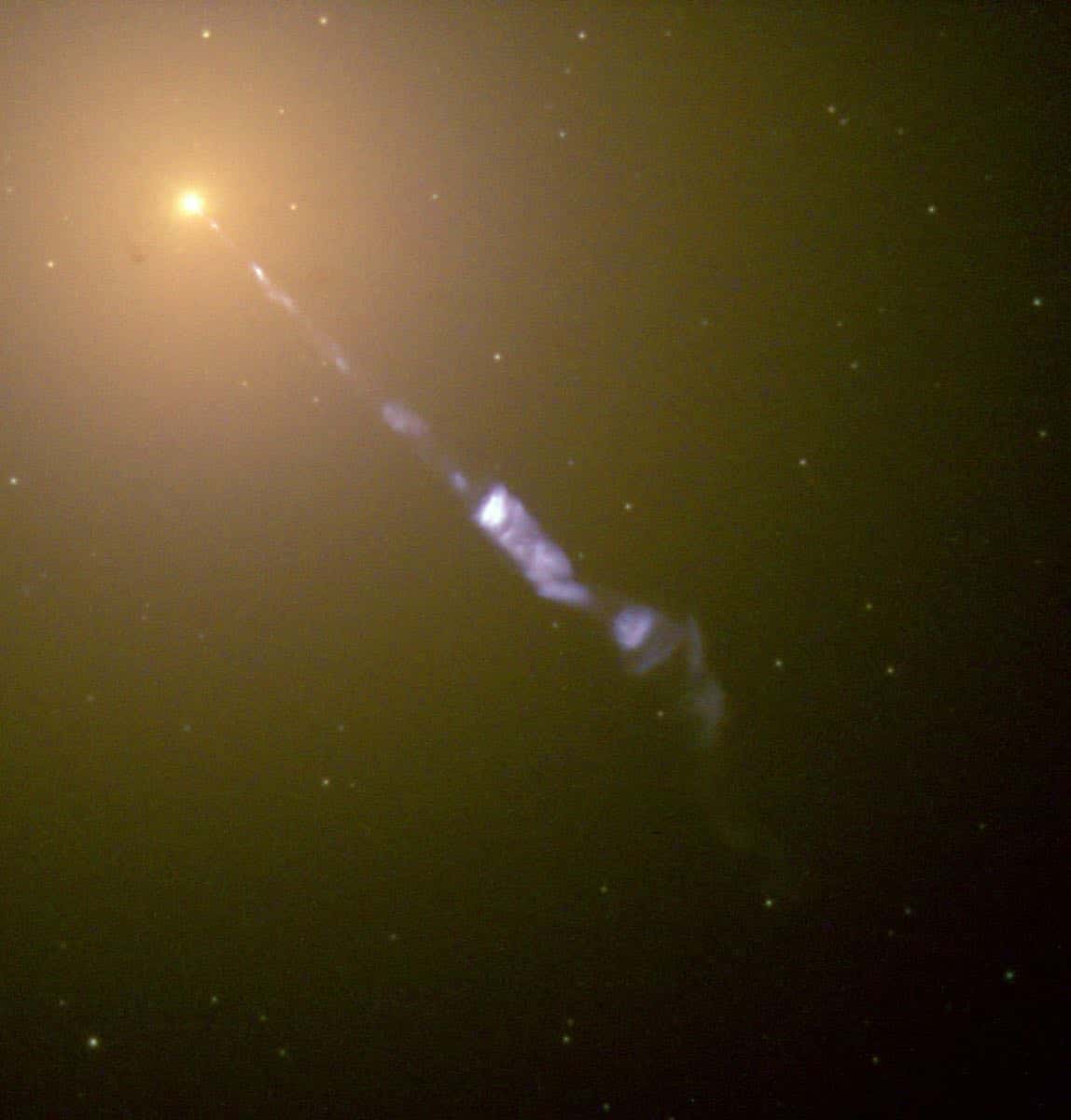
THE M87 JET · NASA / HUBBLE HERITAGE TEAM · PUBLIC DOMAIN
The known landscape
By the early 2020s, astronomers had confirmed something that strains the standard timeline of cosmic history: quasars powered by black holes with masses of hundreds of millions to billions of suns were already blazing when the universe was only 400 to 800 million years old, a small fraction of its present age. Their light has traveled for over 13 billion years to reach us, so what telescopes capture is a snapshot from just after "Cosmic Dawn," the era when the universe's first stars are thought to have ignited roughly 200 million years after the Big Bang.
If the earliest black holes formed from the collapse of these first-generation stars, they would have started as modest "seeds" of perhaps tens to a hundred solar masses. Growing such a seed into a billion-solar-mass quasar within a few hundred million years requires feeding at or near the Eddington limit — the point where the outward pressure of light from hot, infalling gas balances the black hole's inward gravitational pull — almost without interruption. In today's nearby universe, black holes and their host galaxies appear to have grown up together: a central black hole typically makes up only about 0.1 to 0.5 percent of its galaxy's stellar mass.
Observations from the James Webb Space Telescope and the Chandra X-ray Observatory, often aided by gravitational lensing from foreground galaxy clusters such as Abell 2744, have turned this arithmetic problem into a population of real objects. Compact, strikingly red galaxies nicknamed "Little Red Dots" have revealed actively feeding black holes that often look too massive for the small galaxies around them. One, CANUCS-LRD-z8.6, was observed just 570 million years after the Big Bang already hosting a growing supermassive black hole. Elsewhere, a dormant giant six billion times the sun's mass was weighed from the motions of the stars around it, in a quiescent galaxy seen when the universe was roughly 3 billion years old — a black hole that had already stopped feeding.
The edge
Two rival scenarios dominate the debate over how a seed could out-race the Eddington limit. In the "light seed" model, an ordinary stellar remnant of tens to a hundred solar masses gets lucky: born inside an unusually dense star cluster, it gorges on gas quickly enough to keep pace. In the "heavy seed" model, or direct collapse, an entire cloud of primordial gas — stripped of its ability to cool by intense radiation from a nearby galaxy — skips the star-forming stage altogether and collapses straight into a black hole already tens of thousands of solar masses, a head start bought by rarity. A third, "medium seed" pathway proposes that runaway collisions between stars in ultra-dense clusters build intermediate-mass black holes at rates far higher than direct collapse's exacting conditions allow. Some theorists go further, proposing that these early giants formed from self-interacting dark matter halos collapsing under their own gravity, or from primordial black holes seeded within the first fraction of a second after the Big Bang — mechanisms that would need no ordinary star or gas cloud at all.
None of these scenarios can currently be confirmed, because the observations sit at the ragged edge of what today's instruments can measure. The strongest single case for a heavy, direct-collapse seed — a galaxy called UHZ1, whose candidate black hole appeared comparable in mass to its entire host galaxy — has itself become a cautionary tale. A later reanalysis of the full Chandra X-ray dataset, including previously unpublished exposure time, found that the X-ray excess used to identify and weigh the black hole reached a statistical significance of only 2.3 to 2.9 sigma, well below the originally reported 4.2 to 4.4 sigma, and did not grow steadily with additional exposure time the way a persistent real source should. JWST's MIRI instrument, despite being thousands of times more sensitive than earlier telescopes, detected nothing at the same position. The underlying problem is statistical: astronomers are often working with signals of roughly twenty photons against a background of a similar twenty, and every mass estimate built on such sparse counts carries compounding uncertainty. Until larger, statistically robust surveys of these early quasars and Little Red Dots replace single, threshold-level detections, the question of which seed — light, heavy, medium, or something stranger still — actually built the first supermassive black holes remains open.
Contemplative inquiry
If a black hole a billion times the mass of the sun can exist before its host galaxy has finished forming, what does that reordering of "who grew first" suggest about how much of cosmic history is still assumed rather than observed?
When a single, celebrated detection like UHZ1 can shift from landmark evidence to statistical uncertainty on closer scrutiny, how might that change the way you hold any single dramatic scientific claim, in astronomy or elsewhere?
Further
- [2106.08330] Light, medium-weight or heavy? The nature of the first supermassive black hole seeds — arXiv
- The Genesis of Giants: Tracing the Early Development of Supermassive Black Holes — Chandra X-ray Observatory
- A black hole of inexplicable mass — Max-Planck-Gesellschaft
- [2402.18773] Physical Pathways for JWST-Observed Supermassive Black Holes in the Early Universe — arXiv
- Photo Album :: UHZ1 :: November 6, 2023 — Chandra X-ray Observatory
- Webb spots greedy supermassive black hole in early Universe — ESA
- How did supermassive black holes form in the early universe? — Inside UCR, UC Riverside
- [2601.14395] Growth of Light Seed Black Holes in the Early Universe — arXiv
- Revisiting the Claim for a Direct-Collapse Black Hole in UHZ1 at z = 10.05 — arXiv
- Discovery of UHZ1 by JWST and Chandra — evidence for the formation of heavy black hole seeds from direct collapse of gas in the early Universe — Yale University
- [2503.17478] A stellar dynamical mass measurement of an inactive black hole at redshift 2 — arXiv