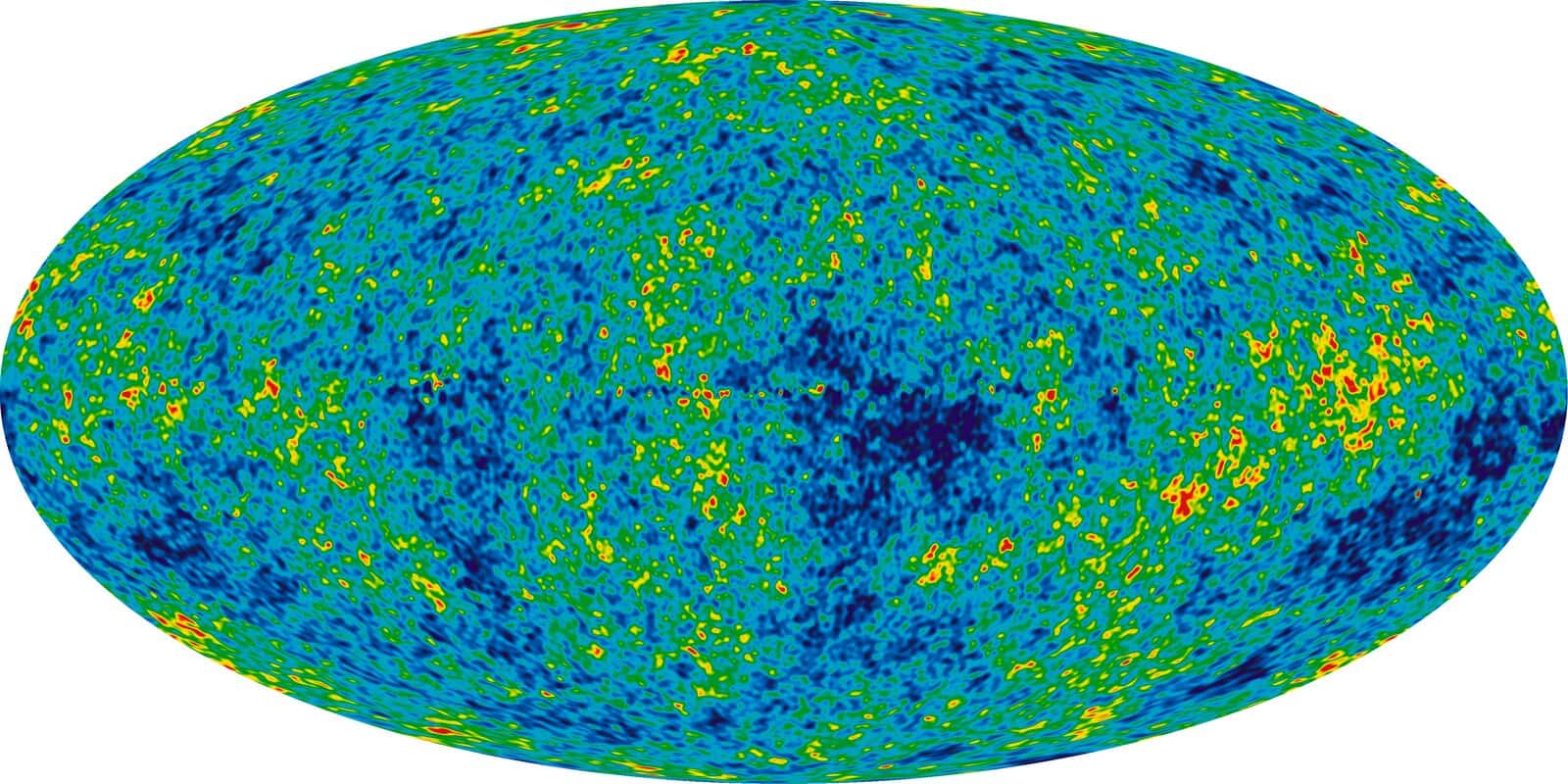
The two largest patterns in the universe's oldest light line up with each other, and with the plane of our own solar system. No explanation has survived scrutiny yet.
CMB ALL-SKY TEMPERATURE MAP · NASA / WMAP SCIENCE TEAM · PUBLIC DOMAIN
The known landscape
In 1965, Arno Penzias and Robert Wilson detected the Cosmic Microwave Background (CMB), the redshifted afterglow of the early universe, dating to roughly 380,000 years after the Big Bang. NASA's COBE satellite confirmed in the early 1990s that this radiation was extraordinarily uniform — a near-perfect 2.725 Kelvin blackbody with temperature variations of only about one part in 100,000 — supporting the standard cosmological model, ΛCDM, and its founding assumption that the universe looks the same in every direction, or statistical isotropy.
Higher-resolution full-sky maps from NASA's WMAP satellite, launched in 2001 and returning its first full-sky results in 2003, and later the European Space Agency's Planck satellite, tested that assumption at the largest observable scales. Cosmologists analyze the CMB's temperature pattern by decomposing it into multipole moments; the lowest of these, the quadrupole (ℓ = 2) and octupole (ℓ = 3), represent the very largest structures in the observable universe, direct imprints of the gravitational potential at the time of the Big Bang. In a statistically isotropic universe, the orientation of these two patterns should be independent and randomly distributed. Instead, researchers found their planes closely aligned — a correlation that different analyses find inconsistent with chance at roughly the 99.6 to 99.97 percent confidence level, meaning odds of somewhere between about one in 250 and one in 3,000. The shared orientation additionally sits close to both the ecliptic, the plane of our own solar system, and the CMB dipole produced by our galaxy's motion.
In 2005, cosmologists Kate Land and João Magueijo gave the anomaly its lasting nickname in a paper in Physical Review Letters: the Axis of Evil, meant to convey how directly a confirmed alignment would threaten the Cosmological Principle at the heart of modern cosmology.
The finding has held up under repeated scrutiny. Independent Planck data-processing pipelines — SMICA, NILC, SEVEM, and Commander, each removing galactic foreground contamination by a different method — all recover the same quadrupole-octupole alignment, and later analyses of Planck's fourth data release, using tools such as the Power Tensor method and a search for dihedral symmetry, continue to find directional structure clustered in the same region of sky.
The edge
Two broad explanations compete, and current data cannot cleanly separate them.
The first treats the axis as an artifact of our own cosmic neighborhood rather than a signal from the early universe. The preferred direction points roughly toward Virgo, home to the Local Supercluster, and researchers including Abramo and Sodré have proposed that hot, diffuse gas in that structure could distort background photons through the Sunyaev-Zel'dovich effect, artificially suppressing the quadrupole and manufacturing a false alignment with the octupole. Modeling and subtracting a foreground of this kind does weaken the alignment in WMAP data. But the foreground hypothesis cannot account for a cluster of otherwise unrelated measurements — a spatial dipole in the fine-structure constant found in quasar spectra, a hemispheric asymmetry in the rotation direction of millions of spiral galaxies, and a coherent alignment in quasar light polarization — that all point toward axes close to the CMB's. A patch of hot gas in one supercluster has no physical mechanism for altering the strength of electromagnetism across the universe or the spin of distant galaxies, which is why local contamination alone has not settled the question.
The second treats the axis as primordial and real, and several candidate causes compete within it: an anisotropic pre-inflationary universe described by Bianchi cosmological models, in which space itself expanded unevenly before inflation smoothed it out; a non-trivial, finite spatial topology (a 3-torus or Poincaré dodecahedral space, for instance) that would let the last-scattering surface fold back on itself; or anisotropic stress generated later by the gravitational collapse of enormous superstructures. A separate group-theory analysis of Planck PR3 data found a specific dihedral D₃ symmetry pattern organizing the low multipoles around an independently optimized candidate axis at (ℓ, b) = (50.3°, −64.9°) — a level of structure standard inflationary theory does not predict.
The dispute persists because the CMB's largest patterns are, by their nature, undersampled: the quadrupole has only 2ℓ + 1 = 5 independent values in the whole observable universe, so no future telescope, however sensitive, can shrink that irreducible cosmic variance. The clearest remaining test — whether the CMB's polarization carries the same axis as its temperature, including cross-correlations that a truly isotropic universe forbids — is still out of reach. Current instruments cannot measure large-scale polarization precisely enough to see it clearly through the glow of the galaxy's own dust.
From the archive
Contrary to earlier claims, we find that the amount of power concentrated in planar modes for ℓ=2,3 is not inconsistent with isotropy and Gaussianity. The multipoles' alignment, however, is indeed anomalous, and extends up to ℓ=5 rejecting statistical isotropy with a probability in excess of 99.9%. There is also an uncanny correlation of azimuthal phases between ℓ=3 and ℓ=5. We are unable to blame these effects on foreground contamination or large-scale systematic errors.
Kate Land and João Magueijo, "The axis of evil," Physical Review Letters 95, 071301 (2005). Archived at arXiv:astro-ph/0502237.
Contemplative inquiry
Physicists gave this anomaly a menacing name for what it would mean if confirmed: that the universe has a preferred direction, and that direction happens to run through our own solar system. What do you notice in yourself on learning that a long-discredited idea — that Earth occupies a special place in the cosmos — might be quietly reasserting itself through statistics rather than belief?
The CMB's largest pattern can, in principle, only ever be measured five independent ways, because there is only one universe and one vantage point from which to observe it. How does it change your relationship to an open question, knowing that more looking will not necessarily produce more certainty?
Further
- Land & Magueijo, The axis of evil — Phys. Rev. Lett. 95, 071301 (2005), arXiv:astro-ph/0502237
- Schwarz, Starkman, Huterer & Copi, Is the low-l microwave background cosmic? — arXiv:astro-ph/0403353
- Cosmic Microwave Background Radiation within the Zwicky Tired Light Hypothesis — arXiv
- Kim, Naselsky & Hansen, Symmetry and anti-symmetry of the CMB anisotropy pattern (arXiv:1202.0728) — arXiv
- Cosmic Microwave Background — arXiv
- Frejsel, Ph.D. thesis on CMB anomalies — Niels Bohr Institute, University of Copenhagen
- CMB Hemispherical Power Asymmetry from an Early Phase of Inflation — arXiv
- Evidence for Dihedral D₃ Symmetry in the Planck CMB Temperature Anisotropy — Preprints.org
- Abramo & Sodré, Local Supercluster foreground analysis (arXiv:astro-ph/0605269) — arXiv
- Examining statistical isotropy of CMB low multipoles from Planck PR4 data — Physics Letters B, via CERN/SCOAP3
- Large-Scale Asymmetry in the Distribution of Galaxy Spin Directions — Symmetry (MDPI)
- Inflationary perturbations in anisotropic backgrounds and their imprint on the CMB — arXiv
- Modelling the emergence of cosmic anisotropy from non-linear structures — arXiv
- Cosmic topology: eigenmodes and correlation matrices of spin-2 perturbations — Journal of Cosmology and Astroparticle Physics, via CSIC Digital Repository
- Exploring Statistical Isotropy in Planck Data Release 4 — arXiv
- Instrument overview of Taurus: a balloon-borne CMB and dust polarization experiment — SPIE Digital Library