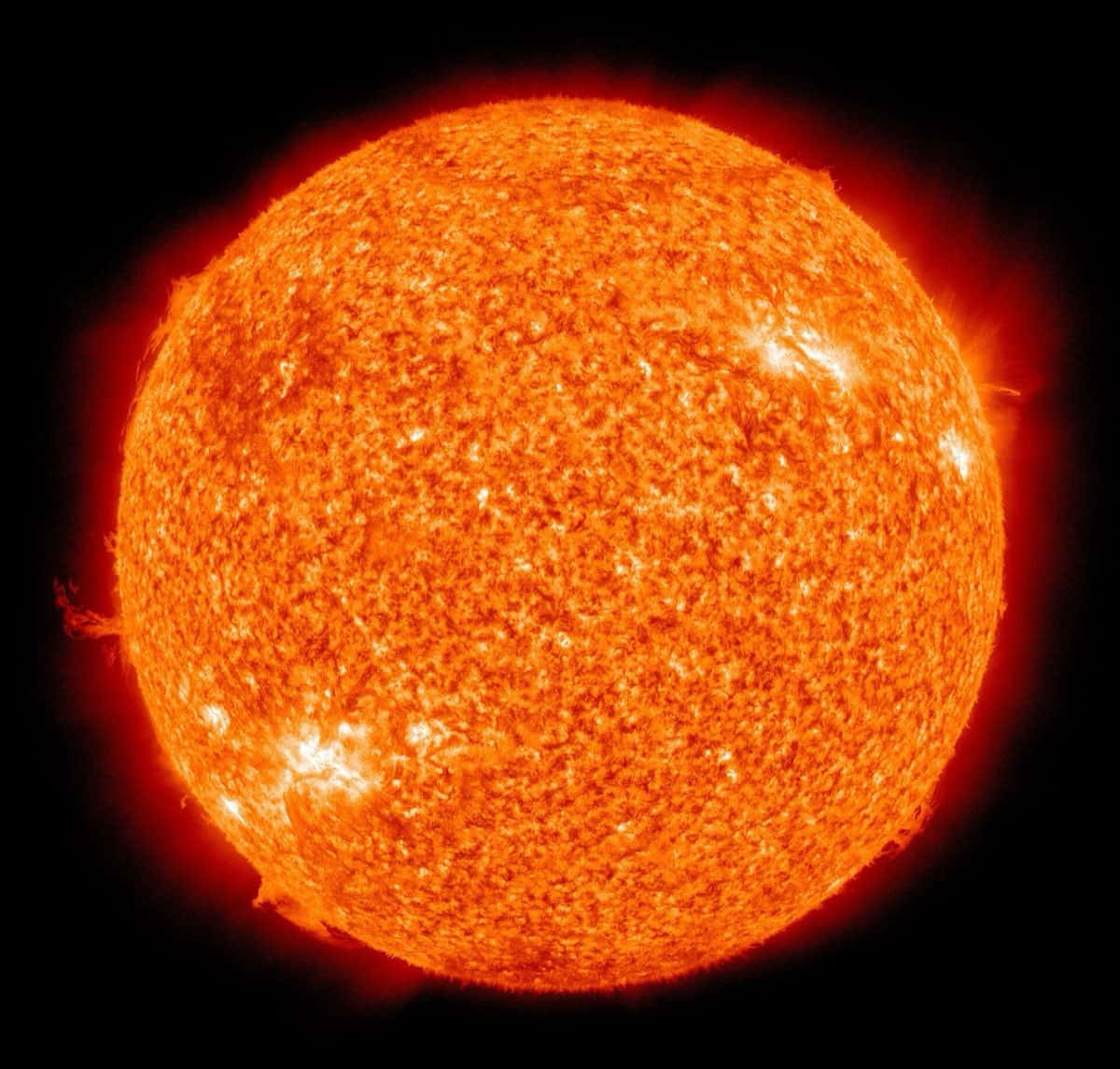
The Sun's corona burns hundreds of times hotter than the surface beneath it. No one has settled why.
THE SUN IN EXTREME ULTRAVIOLET · NASA/SDO · PUBLIC DOMAIN
The known landscape
The Sun's visible surface, the photosphere, radiates like a blackbody at about 6,000 K. Moving outward, temperature should keep falling — and for a short distance it nearly does, warming only modestly through the chromosphere, a thin layer roughly 2,000 kilometers thick, to about 10,000 K. Then, across the transition region, a boundary spanning a mere 100 kilometers, the temperature leaps to between 1 and 3 million K, with active regions of the corona routinely exceeding 5 million K. This defies the ordinary expectation that heat weakens with distance from its source: the corona, the Sun's outermost and most tenuous layer, is far hotter than the surface beneath it. Because heat cannot spontaneously flow from a cooler body to a hotter one, ordinary surface heat conducting upward cannot explain it — something else must be continuously depositing energy into the corona, ultimately traced to the Sun's magnetic field.
The puzzle's history begins with the total solar eclipse of August 1869, when astronomers pointed early spectrographs at the exposed corona and found an unexplained, bright green emission line at 5303 Å that matched no known element. For seventy years, physicists attributed it to a hypothetical new element, "coronium." The mystery unraveled in 1939, when German astrophysicist Walter Grotrian proposed that the line came not from an unknown element but from familiar metals stripped of many electrons — a state requiring extreme heat to produce. Swedish spectroscopist Bengt Edlén confirmed this in 1940–41 through laboratory spectroscopy, identifying the green line as iron stripped of thirteen electrons (Fe XIV) along with other highly ionized species, work for which he received the Royal Astronomical Society's Gold Medal in 1945. Edlén's findings proved the corona exceeded a million degrees. Hannes Alfvén responded that same era with the first theoretical proposal that magnetic processes, not ordinary heat, were responsible, laying groundwork for the study of magnetohydrodynamic waves. Sounding rockets confirmed intense solar X-ray emission in 1949, cementing the corona's extreme temperature as observational fact and turning a chemistry puzzle into a problem in plasma physics.
The edge
Two theoretical frameworks compete to explain how magnetic energy actually becomes coronal heat, and both have genuine observational support without either one winning outright.
Wave heating proposes that convective churning at the photosphere launches magnetohydrodynamic waves — chiefly incompressible Alfvén waves — that travel up the magnetic field into the corona and dissipate their energy through mechanisms such as phase mixing, resonant absorption, or turbulent cascades. Recent observations confirm these waves do damp low in the corona, but how much of the total heating budget they account for remains unsettled. A 2026 study using in-situ Parker Solar Probe data added a further complication: microscopic charged dust grains near the Sun, previously assumed unable to survive coronal temperatures, measurably alter how kinetic Alfvén waves carry and release energy — slowing and spreading their dissipation when dust mass dominates, or triggering rapid, localized bursts when dust charge dominates.
The rival framework, nanoflare theory, formalized by physicist Eugene Parker in a 1988 paper, holds that convection braids and stresses magnetic field lines until they reconnect in innumerable tiny, impulsive bursts, each releasing stored magnetic energy as heat. For nanoflares to dominate coronal heating overall, rather than being a minor contributor alongside occasional large flares, the statistical power law describing how flare frequency scales with flare energy must have a spectral index greater than 2. Measured indices across different studies range from about 1.4 to 3.3 — a spread that straddles that threshold and leaves the question genuinely open, since some data supports nanoflare dominance and some does not.
Why can't current methods settle it outright? The events at the heart of both theories — the smallest-scale wave dissipation and individual nanoflare reconnection events — occur at length and time scales of meters to kilometers and fractions of a second, far below what any existing telescope can resolve from 93 million miles away; they blur into a smooth average glow rather than resolving as distinct events. Spacecraft have gotten closer than ever: Parker Solar Probe discovered magnetic "switchbacks" tied to small reconnection jets at the corona's base, and the Solar Orbiter's Extreme Ultraviolet Imager has shown some large coronal loops behaving in a steady, nearly un-bursty mode rather than the flickering pattern nanoflares would predict. But neither mission can directly measure the magnetic field in the chromosphere and transition region — the very altitudes where the disputed energy is stored and released. Existing instruments reliably measure only the photospheric field below; the true magnetic free energy budget above it remains inferred, not observed. Until a direct chromospheric magnetic-field measurement exists, wave heating and nanoflare reconnection will keep being argued from indirect proxies rather than confirmed against each other directly.
Contemplative inquiry
The corona's furnace runs partly on activity too small to ever see directly — bursts and waves at scales just past the reach of any telescope. What other truths might exist that are simply too small, too fast, or too quiet for our current instruments, or our own attention, to catch?
For seventy years, careful scientists confidently described a nonexistent element, "coronium," because it fit the evidence available at the time. Where else might confident certainty be standing in for a genuine unknown, waiting for a better question to reveal it?
Further
- Ask a Solar Physicist — Stanford Solar Center
- The Coronal Heating Problem — University of Alberta
- Heating mechanisms of the solar corona — PMC, NIH
- Parker, E. N. (1988). Nanoflares and the solar X-ray corona. The Astrophysical Journal, 330:474–479 — NASA Astrophysics Data System
- Evidence for wave heating in the solar corona — PubMed
- The role of turbulence in coronal heating and solar wind expansion — Royal Society Publishing
- A short history of the coronal heating problem — Solar Influences Data Analysis Center (SIDC)
- NASA's Parker Solar Probe and the Curious Case of the Hot Corona — NASA
- Commentary: Discovery of the Sun's million-degree hot corona — Frontiers in Astronomy and Space Sciences
- UAH researcher finds cosmic dust could play key role in cracking long-standing mystery of solar corona heating — University of Alabama in Huntsville
- Scientists May Have Solved Decades-Old Mysteries About the Origins of the Solar Wind — Johns Hopkins Applied Physics Laboratory
- Science nugget: EUI data reveal a "steady" mode of coronal heating — Solar Orbiter, ESA
- Multi-scale Energy Release Events in the Quiet Sun: A Possible Source for Coronal Heating — arXiv
- Solar MAgnetized Regions Tomograph (SMART) Mission — National Academies of Sciences, Engineering, and Medicine
- Quantifying Energy Release in Solar Flares and Solar Eruptive Events — NASA Technical Reports Server