Quantum theory describes a haze of possibilities. Something turns that haze into the single, definite world we experience, and physicists still cannot agree on what.
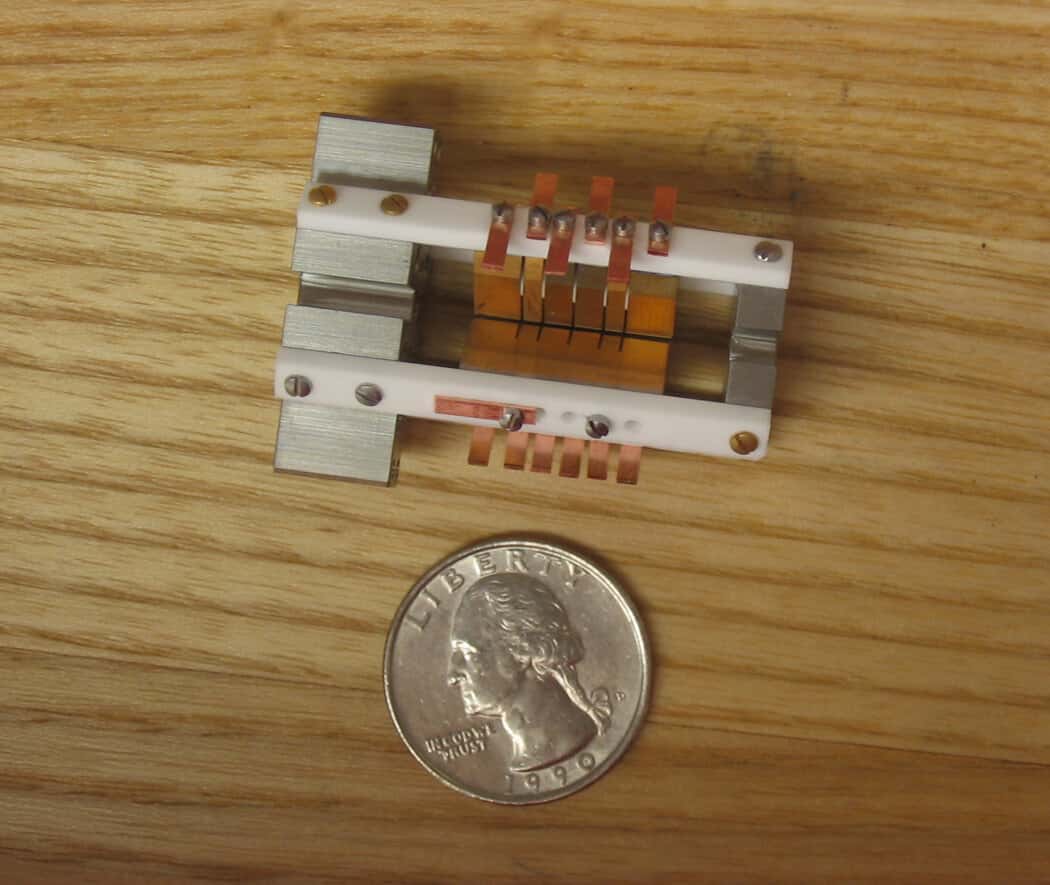
ION TRAP, NIST ALUMINUM-ION CLOCK · NIST · PUBLIC DOMAIN
The known landscape
Standard quantum mechanics rests on two rules that sit uneasily together. Left alone, a quantum system evolves continuously and deterministically under the Schrödinger equation, spreading into a superposition of many possible states at once. But the moment it is measured, that smooth evolution appears to stop: the wave function collapses abruptly into one definite outcome, with the odds of each outcome set by the Born rule. Because a measuring device, and the observer reading it, are themselves built from the same quantum particles that should evolve smoothly, nothing in the mathematics explains why the world we see is ever definite rather than an entangled blur — the puzzle popularly known as Schrödinger's cat.
One proposed answer treats collapse as a real, physical event. In 1986, physicists Giancarlo Ghirardi, Alberto Rimini, and Tullio Weber worked out the GRW theory, in which every particle in the universe undergoes rare, random localization "hits," each narrowing its wave function to a Gaussian spread around a random point. For a lone particle these hits are vanishingly rare, occurring roughly once every hundred million years. But because the particles making up a macroscopic object are entangled with one another, a hit on any single particle collapses the whole object at once; multiplied across the roughly 10²³ particles in something as large as a measuring device, the effective collapse rate rises to about ten million times per second, erasing macroscopic superpositions within a fraction of a microsecond. A later refinement, Continuous Spontaneous Localization (CSL), developed by Ghirardi, Philip Pearle, and Rimini, replaces the discrete hits with continuous random noise acting on mass density.
A second, rival answer, decoherence theory, argues nothing needs to be added to quantum mechanics at all. Pioneered by physicist Wojciech Zurek, it observes that no macroscopic object is ever truly isolated: it is constantly struck by photons, air molecules, and stray fields. That environmental contact entangles system and surroundings so quickly — a dust grain in ordinary air loses its spatial coherence in roughly 10⁻³¹ seconds — that quantum interference washes out almost instantly, leaving behind a classical-looking world without any literal collapse. Zurek extended this into "einselection," explaining why only certain stable "pointer states," generally definite positions, survive; and into Quantum Darwinism, which shows how the environment copies those pointer states redundantly enough that many independent observers can agree on the same reality.
The edge
GRW-type theories and decoherence answer different questions, which is part of why neither has settled the matter. GRW and CSL make a genuinely empirical claim: they alter the Schrödinger equation itself, so in principle they can be confirmed or ruled out by experiment. Physicists are now testing trapped nanoparticles in interferometers for the exact signatures CSL predicts — a loss of visibility, and a faint random heating produced by the model's own stochastic noise. But the predicted collapse rate is so slight, on the order of 10⁻¹⁶ hits per second for a single particle, that its signature sits at the very edge of what tabletop quantum experiments can currently detect, and no confirmation or exclusion has yet emerged.
Decoherence, by contrast, never modifies the equations of quantum mechanics: the combined system-plus-environment always evolves unitarily. That mathematical purity is also its limit. Decoherence explains why we never observe interference between macroscopically distinct states, but it does not by itself explain why any single outcome becomes "the" result rather than every outcome persisting somewhere in an ever-branching wave function. A long-standing charge that the theory is circular — that its reduced density matrices assume the Born rule while trying to derive the very process the Born rule describes — has been answered mathematically through "envariance," symmetries of entangled states used to derive the Born rule from more basic axioms. But that derivation does not settle the deeper question of whether the branches decoherence produces are all equally real.
That tension keeps resurfacing in newer no-go theorems, which point to a fundamental strain between the assumption that quantum mechanics applies universally and the assumption that observed events are absolute and agreed upon by every observer. Perspectival interpretations such as Convivial Solipsism respond by treating each observer's recorded outcome as relative rather than absolute, easing that strain without contradicting any existing experiment. That is exactly the difficulty: every interpretation on the table reproduces the same observable predictions, so no experiment yet devised can choose among them.
Contemplative inquiry
If the solid, particular world in front of you is, on the physics, an emergent record broadcast redundantly through the environment rather than a fixed backdrop, how does that change your felt sense of what it means for something to be real?
When two entirely different physical pictures — one in which wave functions objectively and randomly collapse, another in which nothing ever collapses and only appears to — predict exactly the same experimental results, what would it take for you to call one of them "known"?
Further
- Ghirardi, Rimini & Weber, "Unified dynamics for microscopic and macroscopic systems" — Physical Review D 34, 470 (1986)
- Zurek, "Decoherence, einselection, and the quantum origins of the classical" — arXiv
- Zurek, "Quantum Theory of the Classical: Einselection, Envariance, Quantum Darwinism and Extantons" — PMC, National Library of Medicine
- Schlosshauer, "Quantum decoherence" — Physics Reports 831 (2019)